Blog 8: Independent Component 1 Proposal
Introduction to the world of Military Simulation Gaming
ARMA 3 is a video game, I hesistate to call it a game because of its realistic nature. ARMA 3 has realistic ballistics, combat and even medical systems that has made it into a game that has seized to be so much a game but a military simulator. When I first started playing it three years, I became invested in a type of gaming called "MilSim Gaming." An attempt to make ARMA even more realistic than it already was through usage of mods that added advanced medical systems (so advanced, they require a player in game to know how to administer morphine, check blood pressure and diagnose a patient) and mods that would make the A.I behave even more like real people. For a year, I "served" as a line infantry soldier in multiple different units that operated in MilSim. Eventually, I was promoted to the rank of Staff Sergeant in one of these military simulation units and began leading squads of real guys in game, commanding ten to twelve men in this game. After another six months, I was promoted to the rank of 1st lieutenant and began leading 30 or so men. This investment of time in these units was what lead me to becoming interested in Military Strategy and Tactics. It is important to understand the very realistic nature of ARMA 3, while nothing can ever be the real thing or very close to actual combat, this is the closet that most people get. Because not only does ARMA provide a fun atmosphere, it also provides a place for military veterans to come and still play along the rigid and strict disciplinary standards they had during their time spent in the military. ARMA represents a perfect place to really be able to learn, understand and practice the different military strategies I have been learning throughout my senior project.
Independent Component One - Orthrus Foundation
 |
| Squad Dragonsword of OTSF |
Background
Not too long ago, I was approached my a gentleman named Kessler "Fallen" Smith. He knew of my experience with leading troops in ARMA and made an interesting proposal to me. He wanted to create our own MilSim Unit that would specialize in a form of warfare called Air Mobile. Air Mobile focuses on the idea of High Altitude Low Opening (HALO) Parachuting, referred to as a HALO jump and air assaults via use of helicopters like the MH-6 Little Bird and the UH-60 Blackhawk. In his proposal, he agreed to pay for our voice server, our game server and anything else we needed if I agreed to join the unit as the Lead Training Officer (LTO) and its Operations Coordinator (OC). I wholeheartedly agreed and from that our unit called Orthrus Foundation Combat Operations Wing (OTSF) was founded. We've quickly grown from Kessler, Me and the two other founders to a group of over 25 active members and we continue to expand. When I decided to change my topic to Military Strategy and Tactics, I realized that as the LTO I had an amazing oppurtunity to apply what Im learning in my senior topic to this and vice versa. So I started drawing up a plan on how this would equate to 30 hours of work in a way that was educational.
Part One - The Administrative Stuff
10 Hours
As a founding member, LTO and OC I have a lot to do outside of the gain to make sure everything is running smoothly for our members. I create a Unit Roster (UR) so I know who is currently a part of our organization like the one pictured above this pararaph. The UR contains the emails, names, ranks, and attendance of every member currently a part of OTSF. All to provide an easier time for our non-comissioned officers who have to be able to just look and know who is who, what squad theyre in, and what their personality is. The two most important things in the UR though, is the Player UID and the Attendance sheet both of which are an integral part to making sure our operations run smoothly and everyone is showing up to the training.
Training Curriculums
The next important administrative thing I have to do is creating a training curriculum that I can glance over to make sure that all our guys are on par with the high standards we have for our members. This is done for every single position we have available, if youre a combat medic, you must go through specific combat medic training. If youre a pilot, you must go through 15 hours of pilot training if you want to fly transports and 30 hours if you want to fly air support for ground troops. These different classes are what we call specializations in OTSF, but no matter what specialization you choose, ever member has to go through Infantry Training Courses (ITC) which is also referred to as Small-Unit Operators Course and the curriculum for that is pictured above. The ITC Curriculum consist of ten pages separated into an outline like that picture above and an page where each drill/tactic is summarized.
Hours and Operations
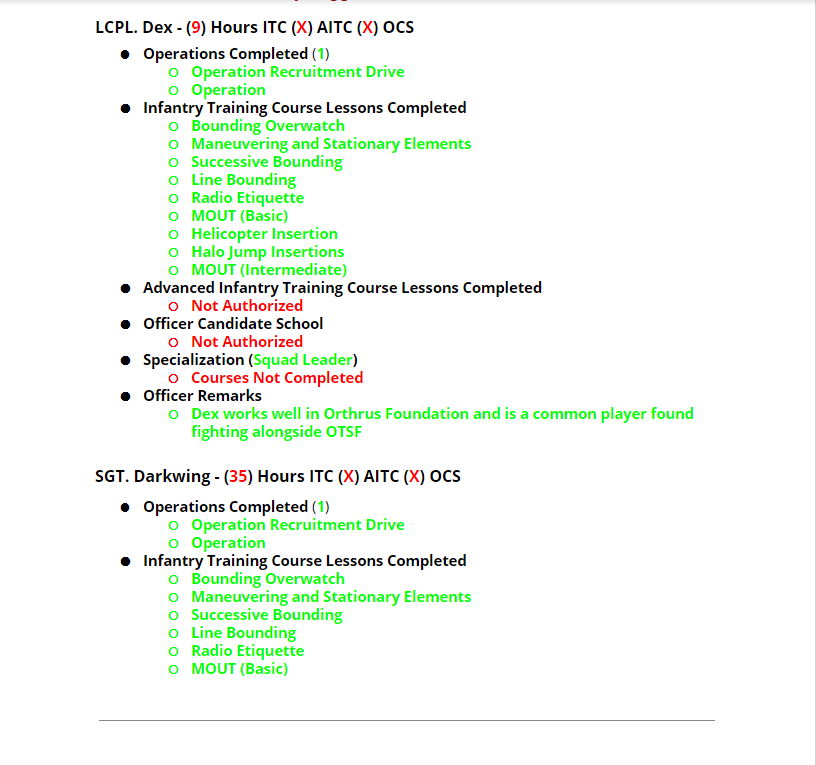
I have to be able to keep track of who has done what training considering how complex and well-developed the training curriculum is and so the second most important thing I have to do administratively is the Hours and Operations Log. This document is the document that keeps track of our members, how many hours of ITC, Advanced ITC, OCS and Specialization training they've gone through because doing that training is integral to ranking up in OTSF. So not only are those hours logged, but the operations theyve completed as part of OTSF, the specific training courses theyve completed and any remarks from officers. This document is the most important document we currently have and is even color coded to make it easier to use. Currently, the Hours and Operations log is about seven pages long.
Server Handling
Finally, the most important thing that must be done in the Administrative section of OTSF is the operation of the dedicated server. A server is something that is needed for gamers to connect to one each other to play games, typically this is very intensive on the computer of whoever is housing the server and can only be up as long as the person housing the server has their ARMA open. But we use what is called a Dedicated Server, which is a server housed at a server farm somewhere in california and is always running so that all our members and any random people can join and play, even while I am offline. As the OC, It is my job to make sure the server is running smoothly for everyone and to even edit the servers configuration files which are pictured above.
Part Two - In-Game Training and Operations
15 Hours
Introduction
ARMA 3 is a military simulator, and so a large portion of the independent component will take place inside the game itself. The picture above is from an operation we did where a convoy of two Humvee's carrying two squads of 5 were providing support for a ground team of eight men pushing into a town. The two humvees are currently laying down supressive fire for the droung team which is sprinting past the two humvees (to the left and off screen). This picture was taken by our official photographer whom has taken all the in-game pictures that you will see and have seen throughout this blog post.
We hold our operations and training every sunday at 5pm PST with training typically lasting two to three hours and operations lasting anywhere from 5 to 8 hours. These operations are done with military simulation in mind and are very professionally done. This is because as a milsim group, as soon as we get in game, we assume the demeanor of an actual military unit completing its objective assigned by high command. You will not hear our guys referring to each other as "brad" or "tom" in videos but as "Alpha 1-1" and "Alpha 1-2."
Why is the ingame portion a part of your independent component?
I think this is a very important question to answer because I think some people might be skeptical of using a game as a component and for hours. Well, my senior topic is Military Strategy and Tactics which is a very hard thing to do for legal reasons of having minors on a base and other types of red tape. The military also wouldnt allow a minor to practice military strategy and tactics with "real" soldiers for obvious legal reasons. ARMA 3 represents the easiest way for me to get a "hands-on" experience with military strategy and tactics. The men underneath my command are real people, even if theyre sitting at computer desk like me, theyre real and they react like real people. It is the best way for me to truly get the experience of commanding people as an officer and applying the tactics that Im reading about in my senior project.
Part Three - Military Strategy and Tactics: The evolution of military tactics from the American Civil War to Post 9/11 (Not done)
I would like the final part of my independent component and the last 5 hours of it to be a ten page essay on military strategy and tactics beginning with the civil war which can be considered the dawn of modern military tactics before ending it at post 9/11 which may in the future be seen as the dawn of a new age of military tactics. This is an important part of the independent component and for the senior project because I think it will help not only show that Ive learned things from ARMA but also because it'll provide a nice paper background for my topic so that the senior team can understand what I find so interesting about the field of military strategy.