1. What are you most proud of in your lesson, and why?
I'm most proud of my speaking which I think was planned out pretty well. I think I need to work a little bit more on enunciation but that is it.
2. What assessment would you give yourself on yourlesson? Explain why you earned that grade using evidence from the component contract.
P, I think I earned a P because I completed everything that was required of me and made my time even though I had a lot more to ralk about then what I afrually did talk about.
3. If you could go back, what would you change about your lesson? How can you use that knowledge to give a betterLesson 2?
I would have changed illustrations because I'm terrible at drawing so I couldn't give an appropiate illustration of what I waneed to do. But in Lesson 2 we will actually be able to use power points so it'll be easier to do.
Friday, November 6, 2015

Thursday, October 29, 2015
Blog 10 - Interview 2 Reflection
Interview on Sound Cloud

1. Please explain how you are spending your mentorship time (Is it at a workplace or somewhere else? Are you shadowing? Are you able to do tasks that are meaningfully related to the topic? If so, what? Are there other people who are experts in the location? Etc...)
I Spend my mentorship time going over military strategy and tactics with my mentor while learning how to lead and what truly makes a leader. We normally work in a small enclosed space for tactics and typically online using military simulators for full fledged military strategy. Typically, I draw strategic battle maps and have to explain to him different ways that an army can attack or he will give me a picture and Ill have to mark out defensive points, kill boxes, avenues of approach and other stuff like that.
2. How did you find your mentor? How did you convince this person to help you?
Ive known my mentor for awhile since hes a United States Marine and it wasnt hard to get him to help me since he knows I eventually want to go into the United States Marine Corp.
3. How would you rate your comfort level with your mentor at this point in your relationship? How does this relate to the time you've spent so far at mentorship/with this person
My mentor and I are very close and I rate it a 9 out of 10 on a scale and its made it a lot easier for me to ask him questions since I already know how he'll react or respond.
4. What went well in this interview? Why do you think so? What do you still need to improve? How do you know? How will you go about it?
Well getting the information went well, probably what could go a little bit better and needs to improve is the ability for us to create a visual picture in the mind of whos listening to the interview. This is because a lot of the stuff we talk about can only be understood if youre already versed in the field of Military Strategy and Tactics.
Wednesday, October 21, 2015
Blog 9 - Advisory Prep 3
Blog 9 - Advisory Prep 3

1. State whether or not you currently have a mentor, and what the status of your interview is with that person (I have completed the interview, I have scheduled the interview, I have not scheduled the interview, etc).
Yes I have a mentor as was said in the previous mentorship blogs and yes Ive scheduled the interview but I havent gotten it done yet.
2. At this point, your research is probably guiding your studies toward more specific areas within your topic. Name the area or two you find most promising and explain your reasons.
My topic was already narrow to begin with and its still the same two areas of Military Strategy and Military Tactics. I chose these two areas because I love learning about commanding multitudes of men and how to maneuver them in a way that best your opponent.
3. What kinds of sources do you think will help you in the next month to gain more research depth? Where will you go to get them?
I will be getting my sources from military training manuals and critically acclaimed books that focus on the military, specifically those dealing with strategy and tactics.
4. Write down a possible EQ. Please don't worry about wording other than ensuring that it provides the option for multiple correct answers. At this point, the senior team is most interested in understanding your thought process.
How can military lessons and strategies developed in the past be applied to future military warfare?
Monday, October 5, 2015
Blog 8: Independent Component 1 Proposal
Blog 8: Independent Component 1 Proposal
.png)
Introduction to the world of Military Simulation Gaming
ARMA 3 is a video game, I hesistate to call it a game because of its realistic nature. ARMA 3 has realistic ballistics, combat and even medical systems that has made it into a game that has seized to be so much a game but a military simulator. When I first started playing it three years, I became invested in a type of gaming called "MilSim Gaming." An attempt to make ARMA even more realistic than it already was through usage of mods that added advanced medical systems (so advanced, they require a player in game to know how to administer morphine, check blood pressure and diagnose a patient) and mods that would make the A.I behave even more like real people. For a year, I "served" as a line infantry soldier in multiple different units that operated in MilSim. Eventually, I was promoted to the rank of Staff Sergeant in one of these military simulation units and began leading squads of real guys in game, commanding ten to twelve men in this game. After another six months, I was promoted to the rank of 1st lieutenant and began leading 30 or so men. This investment of time in these units was what lead me to becoming interested in Military Strategy and Tactics. It is important to understand the very realistic nature of ARMA 3, while nothing can ever be the real thing or very close to actual combat, this is the closet that most people get. Because not only does ARMA provide a fun atmosphere, it also provides a place for military veterans to come and still play along the rigid and strict disciplinary standards they had during their time spent in the military. ARMA represents a perfect place to really be able to learn, understand and practice the different military strategies I have been learning throughout my senior project.
Independent Component One - Orthrus Foundation
 |
| Squad Dragonsword of OTSF |
Background
Not too long ago, I was approached my a gentleman named Kessler "Fallen" Smith. He knew of my experience with leading troops in ARMA and made an interesting proposal to me. He wanted to create our own MilSim Unit that would specialize in a form of warfare called Air Mobile. Air Mobile focuses on the idea of High Altitude Low Opening (HALO) Parachuting, referred to as a HALO jump and air assaults via use of helicopters like the MH-6 Little Bird and the UH-60 Blackhawk. In his proposal, he agreed to pay for our voice server, our game server and anything else we needed if I agreed to join the unit as the Lead Training Officer (LTO) and its Operations Coordinator (OC). I wholeheartedly agreed and from that our unit called Orthrus Foundation Combat Operations Wing (OTSF) was founded. We've quickly grown from Kessler, Me and the two other founders to a group of over 25 active members and we continue to expand. When I decided to change my topic to Military Strategy and Tactics, I realized that as the LTO I had an amazing oppurtunity to apply what Im learning in my senior topic to this and vice versa. So I started drawing up a plan on how this would equate to 30 hours of work in a way that was educational.
Part One - The Administrative Stuff
10 Hours


As a founding member, LTO and OC I have a lot to do outside of the gain to make sure everything is running smoothly for our members. I create a Unit Roster (UR) so I know who is currently a part of our organization like the one pictured above this pararaph. The UR contains the emails, names, ranks, and attendance of every member currently a part of OTSF. All to provide an easier time for our non-comissioned officers who have to be able to just look and know who is who, what squad theyre in, and what their personality is. The two most important things in the UR though, is the Player UID and the Attendance sheet both of which are an integral part to making sure our operations run smoothly and everyone is showing up to the training.
Training Curriculums


The next important administrative thing I have to do is creating a training curriculum that I can glance over to make sure that all our guys are on par with the high standards we have for our members. This is done for every single position we have available, if youre a combat medic, you must go through specific combat medic training. If youre a pilot, you must go through 15 hours of pilot training if you want to fly transports and 30 hours if you want to fly air support for ground troops. These different classes are what we call specializations in OTSF, but no matter what specialization you choose, ever member has to go through Infantry Training Courses (ITC) which is also referred to as Small-Unit Operators Course and the curriculum for that is pictured above. The ITC Curriculum consist of ten pages separated into an outline like that picture above and an page where each drill/tactic is summarized.
Hours and Operations
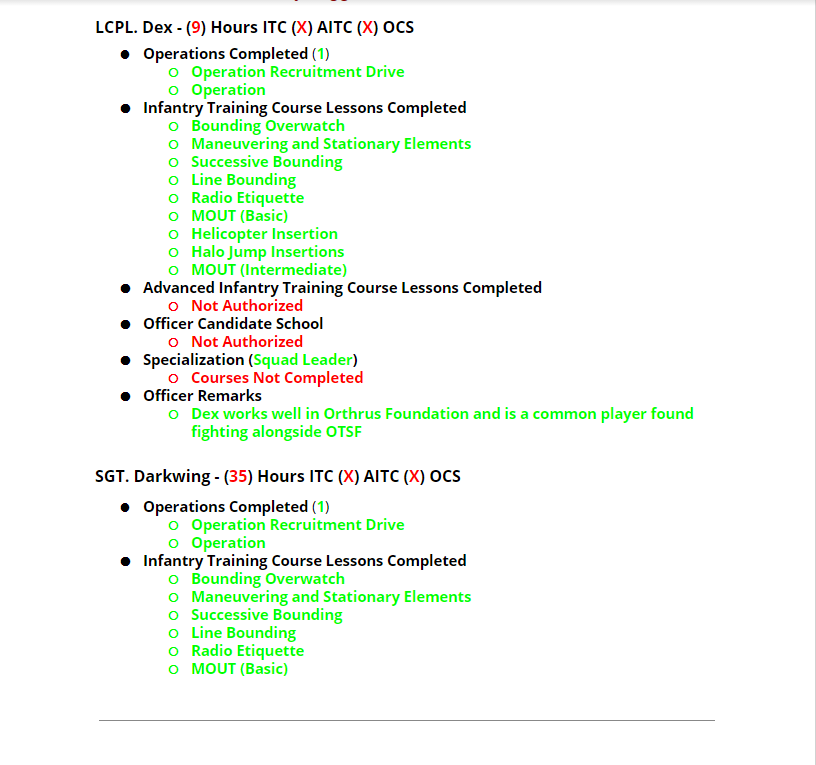
I have to be able to keep track of who has done what training considering how complex and well-developed the training curriculum is and so the second most important thing I have to do administratively is the Hours and Operations Log. This document is the document that keeps track of our members, how many hours of ITC, Advanced ITC, OCS and Specialization training they've gone through because doing that training is integral to ranking up in OTSF. So not only are those hours logged, but the operations theyve completed as part of OTSF, the specific training courses theyve completed and any remarks from officers. This document is the most important document we currently have and is even color coded to make it easier to use. Currently, the Hours and Operations log is about seven pages long.

Server Handling
Finally, the most important thing that must be done in the Administrative section of OTSF is the operation of the dedicated server. A server is something that is needed for gamers to connect to one each other to play games, typically this is very intensive on the computer of whoever is housing the server and can only be up as long as the person housing the server has their ARMA open. But we use what is called a Dedicated Server, which is a server housed at a server farm somewhere in california and is always running so that all our members and any random people can join and play, even while I am offline. As the OC, It is my job to make sure the server is running smoothly for everyone and to even edit the servers configuration files which are pictured above.
Part Two - In-Game Training and Operations
15 Hours

Introduction
ARMA 3 is a military simulator, and so a large portion of the independent component will take place inside the game itself. The picture above is from an operation we did where a convoy of two Humvee's carrying two squads of 5 were providing support for a ground team of eight men pushing into a town. The two humvees are currently laying down supressive fire for the droung team which is sprinting past the two humvees (to the left and off screen). This picture was taken by our official photographer whom has taken all the in-game pictures that you will see and have seen throughout this blog post.
We hold our operations and training every sunday at 5pm PST with training typically lasting two to three hours and operations lasting anywhere from 5 to 8 hours. These operations are done with military simulation in mind and are very professionally done. This is because as a milsim group, as soon as we get in game, we assume the demeanor of an actual military unit completing its objective assigned by high command. You will not hear our guys referring to each other as "brad" or "tom" in videos but as "Alpha 1-1" and "Alpha 1-2."
Why is the ingame portion a part of your independent component?
I think this is a very important question to answer because I think some people might be skeptical of using a game as a component and for hours. Well, my senior topic is Military Strategy and Tactics which is a very hard thing to do for legal reasons of having minors on a base and other types of red tape. The military also wouldnt allow a minor to practice military strategy and tactics with "real" soldiers for obvious legal reasons. ARMA 3 represents the easiest way for me to get a "hands-on" experience with military strategy and tactics. The men underneath my command are real people, even if theyre sitting at computer desk like me, theyre real and they react like real people. It is the best way for me to truly get the experience of commanding people as an officer and applying the tactics that Im reading about in my senior project.
Part Three - Military Strategy and Tactics: The evolution of military tactics from the American Civil War to Post 9/11 (Not done)
I would like the final part of my independent component and the last 5 hours of it to be a ten page essay on military strategy and tactics beginning with the civil war which can be considered the dawn of modern military tactics before ending it at post 9/11 which may in the future be seen as the dawn of a new age of military tactics. This is an important part of the independent component and for the senior project because I think it will help not only show that Ive learned things from ARMA but also because it'll provide a nice paper background for my topic so that the senior team can understand what I find so interesting about the field of military strategy.
Monday, September 28, 2015
Blog 7: Second Interview Preparation
Blog 7 - Second Interview Preparation
 |
| This is a map of a United States Military Operation during the war in Vietnam |
Who is your mentor and where do they work? If their workplace doesn't reflect their expertise, what makes them an expert?
My Mentor is Kyle McDaniel, and he is currently unemployed but will be re-enlisting for the United States Military come October of this year. He is an expert on the subject of Military Strategy and Tactics because as a Designated Squad Leader, it was his job to make sure his ten marines were squared away and ready to go alongside needing to understand the inner working of military tactics especially dealing with MOUT since he was a squad leader whom served a tour in Iraq.
What five questions will you ask them about their background?
Well, the questions I will be asking him will be related to the functions both practical and on paper of a squad. Now I would first like to flesh his background out, so that the listener will be able to understand how credible this source of information is. Now for the questions;
- What is your name, last earned paygrade on active duty and occupational speciality?
- What is a squad in the context of the United States Marine Corp
- How long did it take you to achieve the rank of Designated Squad Leader?
- What were your duties and reponsibilities as a DSL?
- During your tour, how well were you able to adapt to leading a squad on an active duty combat tour?
- Where you typically briefed about a good portion of the operation at hand?
Monday, September 21, 2015
Blog 6 - Advisory House Prep
Advisory House Preparation
1. What has worked well for you concerning the Senior Project? What has made it into a positive experience?
The thing that has worked the best for me concerning the senior project is finding research. There are so many different sources of information regarding the Military that it is very easy for me to fulfill my research requirements. This has helped shaped my experience into a positive one because it has allowed me to finally realize my dream of becoming an officer in the United States Marine Corps.2. What are you finding difficult concerning the Senior Project? How can you adapt to make that portion better for you? What can the senior team do to help?
The most difficult part of the senior project so far was and is finding an active duty member of the United States Military to serve as one of my mentors. It has been incredibly easy for me to find mentors for the tactics part of my topic but not for the strategy part of the project. Most of the reason lies with the fact that its a legal problem to have a minor like me on the base and so its not something I can adapt to nor can the senior team really help me with. I will just have to strive to find a retired officer whom is willing to mentor me.Tuesday, September 15, 2015
Blog 5 - Interview 1
Audio for the Interview

https://soundcloud.com/mirast/interview-2
A brief description; I interviewed Randall Ruelas for my first interview. Randall served as a member of the United States Marine Corps for a total of six years. Eventually reaching the rank of SGT and commanding a platoon. I felt it was necessary and justified to interview him because as a non-commissioned officer in the United States Military, he garnered lots of knowledge pertaining to military tactics and strategy. Specifically the communication aspects of it, like how to most effectively give orders and how to deal with officers you do not like.
What is the most important thing I learned from the interview?
The most important thing that I learned from the interview was that the makings of a leader is not about having tactical brilliance. The makings of a good leader is about the force of will to lead and the ability of you as a person to make your orders sound like they are what is best for whom youre ordering. You must always be happy, or at least nonchalant around your men because how you act, what you say and what you sound like affects how your men follow you. If you're sloppy, you show emotion when you shouldnt and you hesistate when giving orders then your men will follow that example and that example will get them killed. The most important idea to take away from that, is leading consist of the moral part of war and the moral part of war is the most necessary part. Without strong leaders, who can get what needs to be done done and whom can inspire their men, any military plan will fall apart. The communist won their civil war in china, not because of tactical brilliance but because their men were highly motivated and motivation is what drives a soldier. It doesnt matter how well trained you are, if you do not feel motivated enough or compelled enough to follow the officer leading you, then you will break and that training was worth nothing.
Is there anything I would do differently for other interviews?
There really isnt anything that I would do differently in another interview. I think that the interview went very well, I got a lot of information out of it and it allowed me to develop the ideology that I spoke about for the previous question. This interview gave me the insight into the officer corp and the noncomissioned officer corps that I needed to connect my ideas of tactical brilliance with the idea of recognizing that war is fought by people with feelings and not machines without feelings.
Did I get additional resources and contacts?
I didnt really get any additional contacts at all from him specifically. But after speaking to him, I was able to speak to some of the officers still around at the Civil Air Patrol meeting and I was able to make some contacts through that.
What makes my interviewee qualified to help me?
My interviewee is a retired marine sergeant as described in the brief description at the beginning of the post. He served for nearly a decade and in that short time span, due to his dedication to the corps and his ability to efficiently and quickly complete his work he not only rose to the rank of sergeant, he also fulfilled the duties of a rank that was multiple pay grades above him.
Subscribe to:
Comments (Atom)